


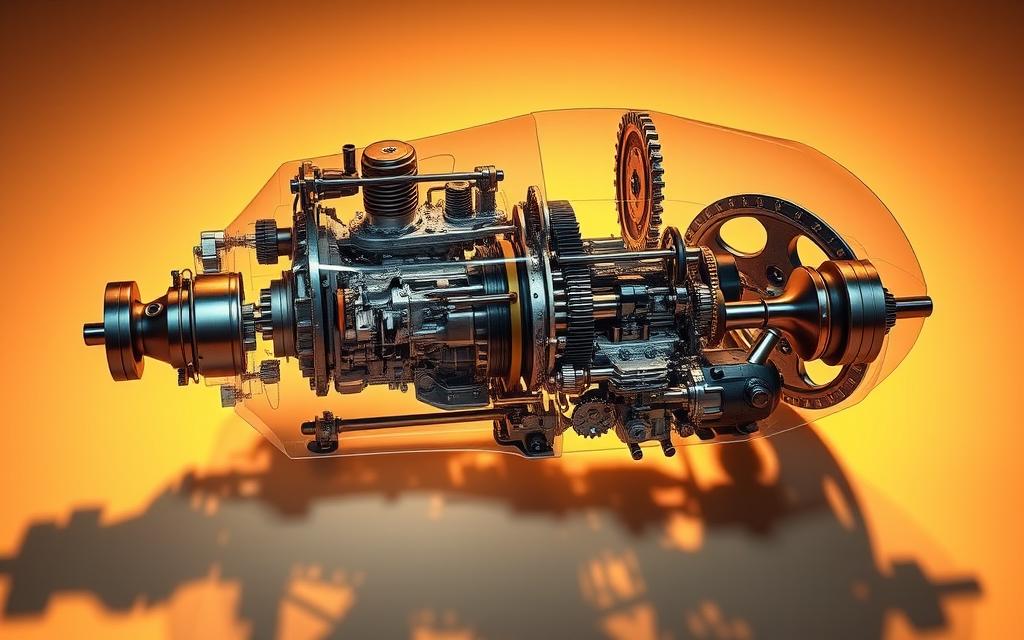
Every vehicle’s movement starts with its powertrain system. This complex system turns fuel into motion. It’s the heart and soul of every car. Knowing what is powertrain technology is crucial for understanding how vehicles operate.
The powertrain system has many key parts. These include the engine, transmission, driveshaft, differential, and axles. They work together to make power and move the vehicle.
Knowing about powertrain technology is important. It affects how well a car performs and how it feels to drive. New technologies are always being developed to improve it.
This knowledge helps with car maintenance and understanding engineering. The next parts will look at each component in more detail. This will give you a deeper understanding of this exciting technology.
Key Takeaways
- 🚗 The powertrain is the core system that converts fuel into vehicle motion, comprising the engine, transmission, and drivetrain.
- ⚙️ Modern powertrains use advanced electronics to synchronize components for optimal performance and fuel efficiency.
- ⛽️ Engine technologies, including petrol and diesel variations, constantly evolve for better power, efficiency, and lower emissions.
- 🔄 Transmission systems (manual, automatic, CVT, DCT) manage power delivery to suit diverse driving conditions.
- 🛣
️ Drivetrain configurations (FWD, RWD, AWD, 4WD) determine how power reaches the wheels, impacting handling and traction.
Defining What Is Powertrain Technology
Powertrain technology is the system that makes a vehicle move. It turns energy into motion. This is different from simpler systems that just move the wheels.
Today’s cars use advanced powertrain systems. These systems aim to be both fast and fuel-efficient. They have come a long way from old mechanical designs to modern electronic systems.
Essential Components of Modern Powertrains
Modern powertrains have key parts that work together well. Five main parts make up every modern powertrain:
- Engine – The main power source that turns fuel into motion through burning.
- Transmission – Changes power delivery to match speed and load needs.
- Driveshaft – Rotating shaft that sends torque from the transmission to the differential.
- Differential – Allows wheels to turn at different speeds when cornering.
- Axles – Final parts that send power to wheels and support the vehicle.
The engine is the heart of the powertrain. It makes power through controlled explosions in its cylinders. Modern engines use tech like turbocharging and direct injection to be more efficient and clean.
Transmission systems have changed a lot. Today, they use electronic controls to pick the best gear ratio for the situation. This is based on driving conditions, load, and performance needs.
Related Posts:
- How Technology Has Helped Us: Advancements in Daily…

- Is China More Technologically Advanced Than the US A…

- How to Manage Technology Strategies for IT and Digital Tools

- What Is DNS Technology The Internet's Phonebook

- What Is mmWave Technology High-Frequency 5G Explained

- How to Enable Virtualization Technology on Lenovo…

The driveshaft connects the transmission to the differential. It sends rotational force and moves with the suspension. Its design changes depending on whether the car is front-wheel or rear-wheel drive.
Differential technology helps with smooth cornering. It lets wheels on the same axle turn at different speeds. Advanced types like limited-slip and electronic differentials improve grip in tough conditions.
Axles are the last part of the power delivery chain. They support the vehicle’s weight and send power to the wheels. Their design and materials have improved a lot to handle the power from modern engines.
These parts must work together perfectly for the best performance. Modern cars use advanced electronic control units. These units keep an eye on and adjust how the parts work for top efficiency and reliability.
Internal Combustion Engine Technologies
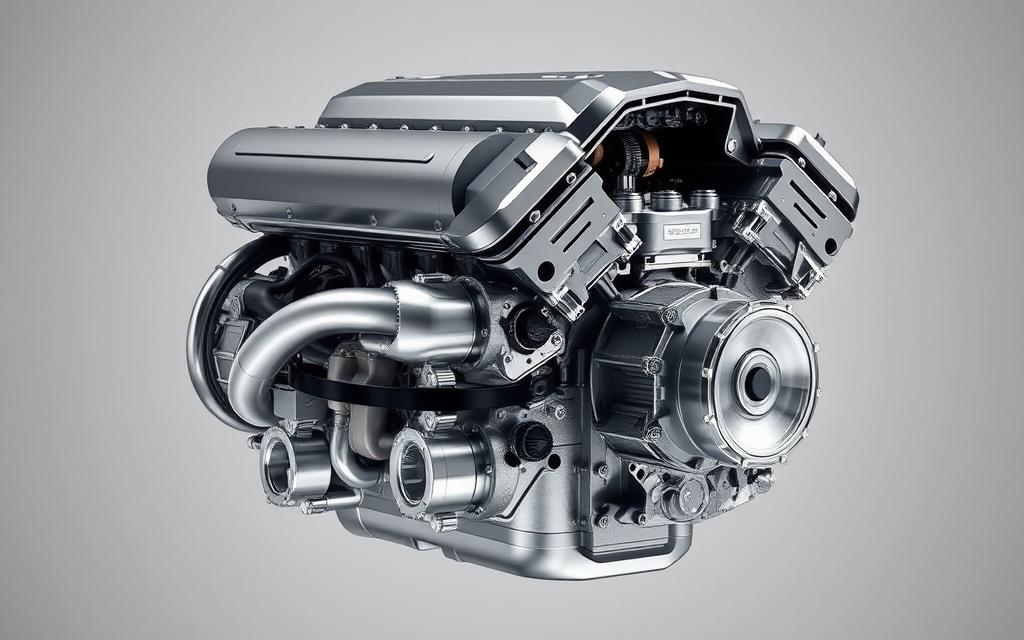
Today’s engines are much more advanced than the old ones. They turn fuel into mechanical energy efficiently and meet strict emissions rules. This has made them better for performance and the environment.
Petrol versus Diesel Engine Characteristics
Petrol and diesel engines work in different ways. Petrol engines use a spark to start the fuel mix. Diesel engines compress air until it’s hot enough to ignite the fuel.
Diesel engines are more efficient and save fuel, which is great for heavy loads. They also produce more torque at lower speeds.
Petrol engines are lighter and have more power at high speeds. They also produce less nitrogen oxide, but diesel engines have improved in this area too.
New technologies have made petrol and diesel engines more similar. For example, gasoline direct injection and turbocharging have boosted petrol engine efficiency. Diesel engines now have filters and catalytic reduction to meet emissions standards.
Engine Configuration and Displacement Options
Engine layout affects how well an engine fits in a car and how it performs. The main types are inline, V-type, and flat engines, each suited for different cars.
Inline engines are simple and cost-effective. They work well in cars with four or six cylinders. They’re often used in front-wheel drive vehicles because they’re compact.
V-type engines have cylinders in two banks at an angle. This makes them more compact for more cylinders. They’re used in performance and luxury cars.
Flat or boxer engines have cylinders laid out horizontally. This design improves handling by lowering the car’s centre of gravity. It’s popular in sports cars and some SUVs.
Engine size is important for performance, but modern tech has changed this. Bigger engines used to mean more power, but now smaller engines can be just as powerful with turbocharging or supercharging.
The Department of Energy says modern engines have many new features. These include variable valve timing and exhaust gas recirculation systems. These help engines run more efficiently and produce fewer emissions.
Modern engines also have more valves for better airflow. With advanced management systems, they can produce more power from smaller engines. This meets strict environmental rules.
Transmission System Technologies
Transmission systems link engine power to wheel movement. They adjust engine output for different driving conditions. This ensures the best performance at various speeds and terrains. Modern cars use several types of transmissions, each with its own benefits.
Manual Transmission Operation and Benefits
Manual transmissions need the driver to choose gears using a clutch pedal and gear lever. This system uses fixed gear ratios that the driver picks based on speed and conditions.
The main advantages of manual transmissions are:
- Greater driver control over gear selection and engine braking.
- Typically lower maintenance costs than automatics.
- Improved fuel efficiency with skilled driving.
- Simpler design with fewer parts.
Many drivers love manual systems for the fun they offer. The direct connection between driver and vehicle makes driving more engaging than automatics.
Automatic Transmission Advancements
Automatic transmissions have come a long way from their early days. Today, they use electronic controls and smart shifting algorithms that adapt to driving conditions.
Modern automatics include:
- Continuously Variable Transmissions (CVTs) for smooth acceleration.
- Dual-Clutch Systems (DCTs) for quick gear changes.
- Adaptive shift programming that learns driver habits.
- Electronic control units for better shift points.
These updates have made automatics much better. They often beat manuals in fuel economy and speed, yet are easy to use.
| Transmission Type | Operation Method | Primary Advantages | Typical Applications |
|---|---|---|---|
| Manual Transmission | Driver-operated clutch and gear lever | Lower cost, driver engagement, mechanical simplicity | Entry-level vehicles, performance cars |
| Traditional Automatic | Hydraulic torque converter with planetary gears | Smooth operation, ease of use, reliable performance | Family vehicles, luxury cars |
| Continuously Variable (CVT) | Steel belt and variable pulleys | Seamless acceleration, fuel efficiency, compact design | Compact cars, hybrid vehicles |
| Dual-Clutch (DCT) | Two separate clutches for odd/even gears | Rapid shifts, performance-oriented, efficient power transfer | Sports cars, high-performance vehicles |
Transmission systems keep getting better, aiming for more efficiency, quickness, and driver happiness. Whether it’s manual or automatic, today’s transmissions are key to delivering power smoothly from engine to wheels.
Drivetrain Configurations and Systems
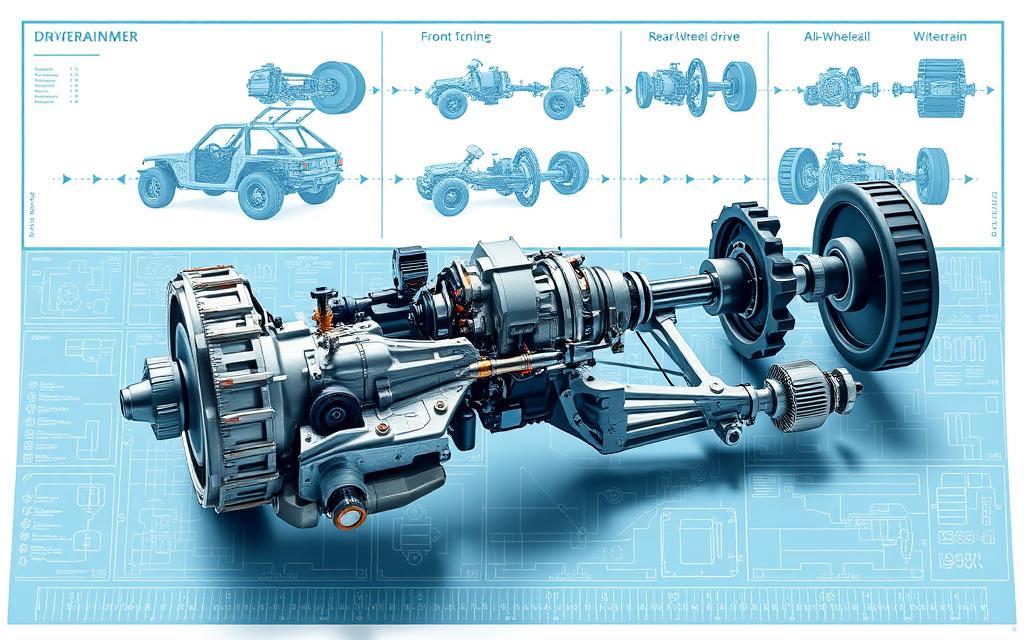
The power journey from engine to wheels goes through drivetrain configurations. Each has its own benefits for different driving needs and vehicle types. These systems decide how power reaches the wheels, affecting handling, traction, and vehicle performance.
Front-Wheel and Rear-Wheel Drive Systems
Front-wheel drive (FWD) sends power only to the front wheels. It has many advantages:
- It’s better for fuel efficiency because it’s lighter.
- It gives better grip in wet weather.
- It means more room inside because there’s no transmission tunnel.
Economy cars and family vehicles often use FWD. It’s cost-effective and handles well. The engine’s weight helps in bad weather.
Rear-wheel drive (RWD) sends power to the rear wheels. It offers a different driving feel. This setup is good for:
- Improved handling due to better weight distribution.
- Better acceleration as weight moves to the rear wheels.
- Less torque steer during quick starts.
Sports cars and luxury vehicles prefer RWD. It balances handling and performance. It also lets drivers control the vehicle more precisely.
All-Wheel Drive and Four-Wheel Drive Technologies
What is the difference between AWD and 4WD?
The difference between AWD vs 4WD systems is key in modern powertrain tech. Both send power to all four wheels but in different ways for different needs.
All-wheel drive systems work automatically. They adjust power between axles as needed. Modern AWD offers:
- Smooth operation without driver help.
- Better stability on different roads.
- Improved performance for daily driving.
Crossovers and performance vehicles use AWD. It’s great for all-weather driving and sporty handling. The system focuses on on-road performance with some off-road ability.
Four-wheel drive systems are for serious off-road adventures. They have:
- Manual options for full control.
- Low-range gearing for tough conditions.
- Stronger durability for off-road use.
SUVs and trucks for serious off-roading use 4WD. It has locking differentials and transfer cases. These systems offer the best traction in mud, snow, or rocky terrain.
Knowing these systems helps drivers pick the right vehicle. Whether it’s for fuel efficiency, performance, or off-road use.
Powertrain Integration and Synchronisation
Modern cars work together like a well-oiled machine. This is thanks to advanced electronic management. It makes the engine, transmission, and drivetrain work as one.
The powertrain control module is at the core of this. It’s a smart computer that controls everything. It uses data from many sensors in the car.
This module adjusts things in real-time. It finds the best mix of power and fuel use, based on how you drive.
Engine management is a big part of what the PCM does. It tweaks the air-fuel mix, ignition, and valve timing for better combustion.
Transmission control is also key. The PCM decides when to shift gears and how smoothly, based on how fast you’re going and how hard you’re pressing the gas.
Drivetrain engagement is another area the PCM focuses on. It makes sure the right amount of torque goes to each wheel for better grip and stability.
Modern PCM systems can even guess what you might do next. This helps them make smoother transitions between different driving modes.
The PCM also looks after emissions and fuel efficiency. It makes sure the car meets environmental standards while keeping performance high.
| System Component | PCM Control Function | Performance Benefit | Efficiency Impact |
|---|---|---|---|
| Engine Management | Optimises air-fuel ratio and ignition timing | Maximises power output | Reduces fuel consumption by 8-12% |
| Transmission Control | Calculates ideal shift points and smoothness | Enhances acceleration response | Improves fuel economy by 5-9% |
| Drivetrain Engagement | Manages torque distribution between wheels | Increases traction and stability | Minimises energy loss through slippage |
| Emissions Systems | Monitors and adjusts catalytic converter operation | Maintains performance standards | Ensures compliance with regulations |
Modern PCM systems also have diagnostic tools. They keep an eye on the car’s health and warn you of any problems.
Now, powertrain control module systems use machine learning. They learn your driving habits and adjust to make the car even better for you.
The way modern cars work together is a true marvel of engineering. This electronic harmony makes driving powerful yet easy.
Modern Powertrain Innovations
The car world is changing fast, thanks to electric power. This change is making cars smarter and cleaner. It’s a big shift from the old days of just using engines.
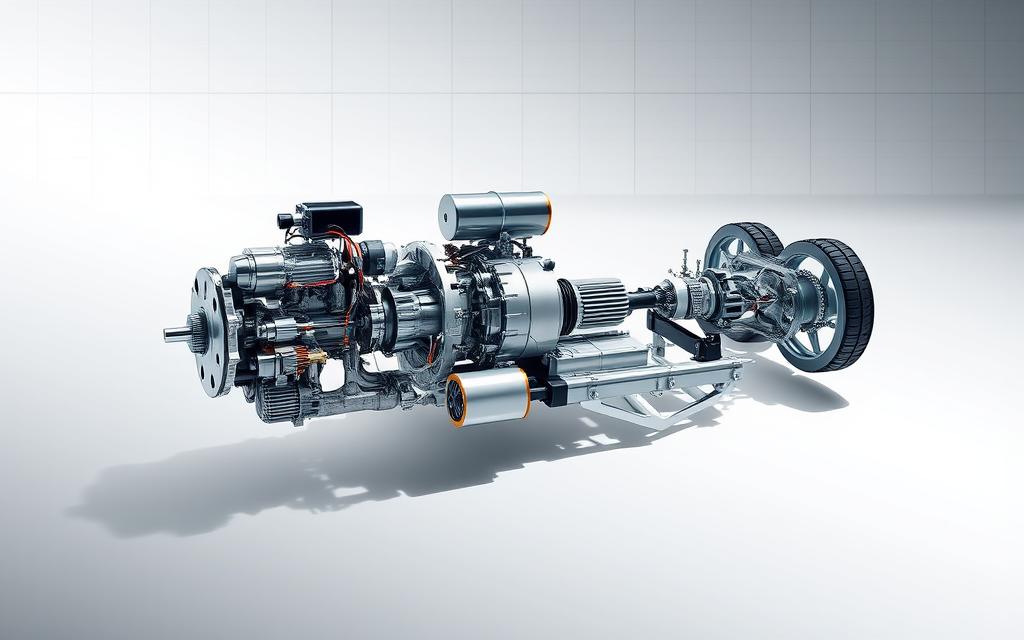
Hybrid systems are a middle ground between old cars and electric ones. They mix engines with electric motors and batteries. This mix makes cars use less fuel and pollute less, without losing range.
There are different kinds of hybrids:
- Parallel hybrids let the engine and electric motor work together.
- Series hybrids use the engine to charge the battery.
- Plug-in hybrids have big batteries that can be charged outside for longer electric trips.
Battery electric vehicles (BEVs) are the next big thing. They don’t have engines and use electric motors and batteries. They go fast and don’t pollute.
Fuel cell electric vehicles (FCEVs) are also new. They make electricity from hydrogen and oxygen, leaving only water behind.
Experts say big changes are coming soon. Electric cars, including hybrids and BEVs, will cost the same as old cars by 2025. This could make more people choose electric cars.
These new ideas are changing how cars are made. Engineers now focus on saving energy and making cars work better. The hybrid powertrain is not just a new way to power cars, but a whole new way to think about them.
Companies are spending a lot on new battery tech and power systems. They want to make cars that are not just fast, but also smart and adapt to how you drive.
This change isn’t just for cars. Trucks, bikes, and even boats are going electric too. The idea of using different power sources is working well in many areas.
As these techs get better, car makers and tech companies are working together more. This teamwork is speeding up new ideas and bringing advanced tech to cars.
Conclusion
Powertrain technology is at the core of any vehicle. It combines the engine, transmission, and drivetrain into one system. This system affects how fast the car goes, how it handles, and how safe it is to drive. Understanding what is powertrain technology helps you appreciate the engineering behind every drive.
How to Maintain Your Vehicle’s Powertrain System
-
Consult Your Owner’s Manual
Read your vehicle’s owner’s manual to understand the recommended maintenance schedule and specific fluid requirements for your powertrain components. This is the first and most crucial step.
-
Perform Regular Oil Changes
Regularly change your engine oil and oil filter according to the manufacturer’s recommendations. Fresh oil lubricates engine components and helps prevent wear.
-
Check Transmission Fluid
Inspect your transmission fluid level and quality. Low or dirty fluid can lead to transmission problems. Some modern transmissions are ‘sealed for life’ but still require periodic inspection by a professional.
-
Monitor for Warning Signs
Pay attention to any unusual noises, vibrations, smells, or performance issues. These can be early indicators of powertrain problems, such as strange shaking, burning smells, slipping gears, or fluid leaks.
-
Seek Professional Inspection for Issues
If you notice any warning signs, have your vehicle inspected by a qualified mechanic immediately. Early diagnosis can prevent minor issues from becoming costly repairs.
The car industry is always improving powertrain systems. Hybrid and electric cars bring new ways to power vehicles. Yet, they stick to the basic ideas of how power is delivered. This keeps cars getting better and more efficient over time. Future innovations, like advanced battery chemistries and smarter control modules, promise even greater performance and sustainability.
Looking after your powertrain means your car will run smoothly and reliably for a long time. Regular maintenance keeps this complex system working well. It makes sure your driving is safe and fun for many years. Don’t wait for problems to arise; proactive care is the best approach to ensure your vehicle’s powertrain performs optimally throughout its lifespan.
