

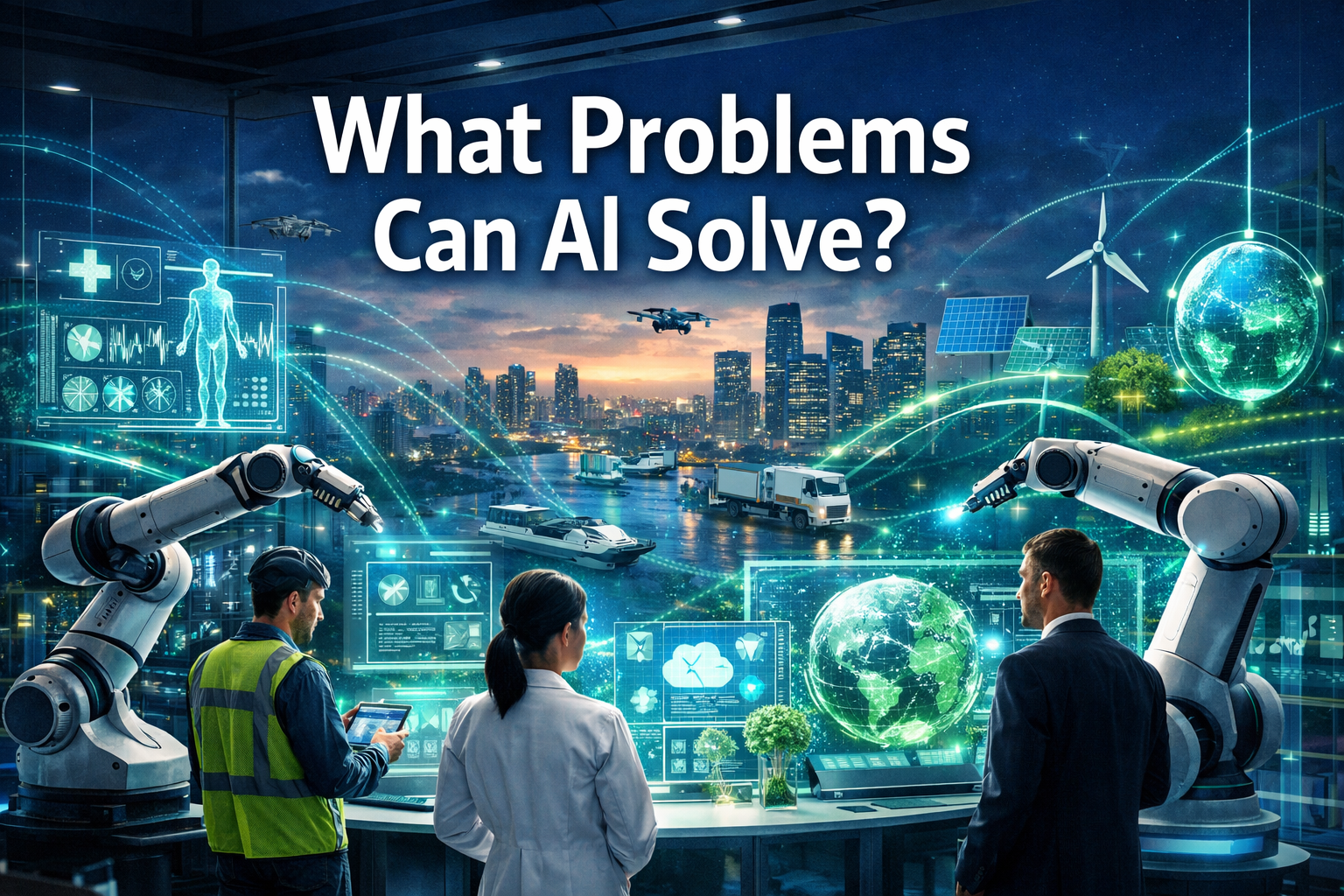
Artificial Intelligence (AI) has rapidly transitioned from the realm of science fiction into a tangible force, reshaping industries and daily life. But beyond the headlines and buzzwords, what problems can AI solve today, in 2026, and what potential does it hold for the future? This comprehensive article dives deep into the diverse applications of AI, exploring its remarkable capabilities in tackling some of the world’s most pressing challenges, from mundane tasks to complex global issues.
Key Takeaways
- Automation & Efficiency: AI excels at automating repetitive tasks, processing vast datasets, and optimizing operations across various sectors, leading to significant cost savings and increased productivity.
- Enhanced Decision-Making: By analyzing complex information and identifying patterns, AI provides insights that empower humans to make more informed and strategic decisions, reducing errors and risks.
- Personalization & Customization: AI can tailor experiences, products, and services to individual needs, improving user satisfaction in areas like education, healthcare, and e-commerce.
- Solving Complex Global Challenges: From accelerating scientific discovery and climate modeling to improving disaster response and agricultural yields, AI offers powerful tools to address large-scale societal issues.
- Accessibility & Inclusivity: AI-powered technologies are breaking down barriers for individuals with disabilities, offering new avenues for communication, mobility, and independence.
Unpacking the Power: What Problems Can AI Solve in Operations and Business?
The business landscape has been profoundly transformed by AI, which offers solutions to a myriad of operational challenges. From streamlining workflows to enhancing customer interactions, AI is becoming indispensable for competitive advantage.
Streamlining Operations and Enhancing Efficiency
One of the most immediate answers to what problems can AI solve lies in its ability to automate, optimize, and streamline business operations.
Questions about problems can solve also connect with enable virtualization lenovo pcs when readers compare closely related topics.
This discussion overlaps with dns internet phonebook, especially for readers comparing problems can solve with similar issues.
- Repetitive Task Automation: Many roles involve monotonous, time-consuming tasks. Robotic Process Automation (RPA), often powered by AI, can handle data entry, invoice processing, inventory management, and even email sorting. This frees up human employees to focus on more creative, strategic, and high-value work.
- Example: A large financial institution uses AI to process millions of transactions daily, flagging suspicious activities for human review and reducing manual reconciliation errors by over 80% [1].
- Supply Chain Optimization: AI algorithms can analyze vast amounts of data—weather patterns, geopolitical events, consumer demand fluctuations, transportation logistics—to predict potential disruptions and optimize inventory levels, routing, and delivery schedules. This minimizes waste, reduces costs, and improves delivery times.
“AI isn’t just about faster calculations; it’s about anticipating the future of our supply chains, making them more resilient and responsive than ever before.” – Logistics Industry Expert
- Predictive Maintenance: In manufacturing and infrastructure, AI analyzes sensor data from machinery to predict when equipment is likely to fail. This allows for proactive maintenance, preventing costly breakdowns, extending asset lifespan, and ensuring continuous operation.
- Impact: A major airline reported a 15% reduction in unscheduled maintenance events by deploying AI for predictive analysis on its aircraft engines [2].
Elevating Customer Experience and Engagement
AI plays a crucial role in improving how businesses interact with their customers, leading to greater satisfaction and loyalty.
- Intelligent Chatbots and Virtual Assistants: These AI-powered tools handle routine customer inquiries 24/7, providing instant support, answering FAQs, and guiding users through processes. They can significantly reduce call center volumes and wait times. Advanced chatbots can even understand context and transfer complex issues to human agents seamlessly.
Benefit Description Impact 24/7 Availability Customers get instant help anytime, anywhere. Improved customer satisfaction, global reach. Reduced Wait Times Queries are resolved quickly without human agent intervention. Lower operational costs, happier customers. Consistent Answers Provides uniform, accurate information every time. Enhanced brand reliability, reduced errors. Scalability Handles thousands of concurrent interactions effortlessly. Supports rapid growth without staffing spikes. Data Collection Gathers valuable insights on customer pain points and preferences. Informs product development and service improvement. - Personalized Recommendations: E-commerce platforms, streaming services, and content providers leverage AI to analyze user behavior, preferences, and past interactions. This allows them to offer highly tailored product suggestions, content recommendations, and advertisements, increasing engagement and sales.
- Fun Fact: Netflix’s recommendation engine, powered by AI, is estimated to save the company over $1 billion annually by reducing churn and increasing viewer engagement [3].
- Sentiment Analysis: AI can analyze customer feedback from surveys, social media, and reviews to gauge sentiment and identify emerging issues or areas for improvement. This allows businesses to respond proactively to customer concerns and adapt their strategies.
Enhancing Security and Fraud Detection
Security is a major concern for individuals and organizations alike. AI offers robust solutions to combat threats.
- Fraud Detection: Financial institutions use AI to monitor transactions in real-time, identifying unusual patterns or anomalies that may indicate fraudulent activity. These systems can detect subtle deviations from normal behavior that human analysts might miss.
- Example: AI-powered systems have helped banks reduce credit card fraud losses by up to 70% in some cases, by quickly flagging and blocking suspicious transactions [4].
- Cybersecurity: AI analyzes network traffic, system logs, and threat intelligence to detect and neutralize cyber threats, including malware, phishing attacks, and intrusion attempts. Machine learning algorithms can learn to identify new and evolving attack vectors.
- Physical Security: Facial recognition, object detection, and behavioral analytics powered by AI can enhance surveillance systems, identifying unauthorized access, suspicious behavior, or potential threats in public and private spaces.
Addressing Complex Challenges: What Problems Can AI Solve in Science and Society?
Beyond business operations, AI is proving to be a game-changer in tackling some of the most significant scientific and societal challenges facing humanity.
Accelerating Scientific Discovery and Research
The speed and scale at which AI can process and interpret data are revolutionizing scientific research.
- Drug Discovery and Development: AI algorithms can analyze vast chemical libraries, predict molecular interactions, and identify potential drug candidates much faster than traditional methods. This significantly shortens the drug discovery pipeline and reduces costs.
How AI Accelerates Drug Discovery
- Step 1: Target Identification – AI analyzes biological data to pinpoint disease-causing proteins.
- Step 2: Molecule Screening – Rapidly screens billions of compounds for potential efficacy.
- Step 3: Predictive Modeling – Forecasts drug effectiveness, toxicity, and side effects.
- Step 4: Clinical Trial Optimization – Identifies ideal patient cohorts and trial designs.
- Material Science: AI helps researchers design new materials with specific properties by simulating atomic and molecular interactions, leading to advancements in everything from batteries to aerospace components.
- Climate Modeling and Environmental Monitoring: AI processes complex climate data, improving predictions of weather patterns, climate change impacts, and natural disasters. It also monitors deforestation, pollution levels, and wildlife populations from satellite imagery and sensor networks.
- Achievement: AI-driven models have improved the accuracy of long-range weather forecasts by 10-15%, crucial for agriculture and disaster preparedness [5].
Enhancing Healthcare and Medical Diagnostics
AI’s ability to analyze medical data at scale is transforming diagnostics, treatment, and patient care.
- Medical Imaging Analysis: AI-powered tools can analyze X-rays, MRIs, CT scans, and pathology slides with incredible speed and accuracy, often identifying subtle anomalies that human eyes might miss. This aids in early detection of diseases like cancer, diabetic retinopathy, and neurological disorders.
- Example: Deep learning algorithms have shown comparable or even superior performance to expert radiologists in detecting breast cancer from mammograms [6].
- Personalized Medicine: By analyzing a patient’s genetic profile, medical history, lifestyle data, and treatment responses, AI can recommend highly personalized treatment plans and drug dosages, leading to more effective outcomes with fewer side effects.
- Disease Outbreak Prediction: AI can track and analyze data from various sources—social media, news reports, travel patterns, and clinical data—to predict the spread of infectious diseases, allowing public health officials to intervene earlier and more effectively.
- Emoji Moment:🌍✈️
📊 AI helps track global health trends!
- Emoji Moment:🌍✈️
Improving Accessibility and Inclusivity
AI is a powerful tool for breaking down barriers and creating a more inclusive world for individuals with disabilities.
- Assistive Technologies: AI-powered speech-to-text and text-to-speech converters, real-time captioning, and sign language translation tools greatly assist individuals with hearing and speech impairments.
- Navigation and Mobility Aids: AI-driven navigation apps provide detailed, real-time guidance for visually impaired individuals, helping them safely traverse unfamiliar environments. Robotics and AI also contribute to advanced prosthetics and exoskeletons.
- Personalized Learning for Special Needs: AI can adapt educational content and delivery methods to suit the unique learning styles and needs of students with diverse abilities, ensuring a more equitable learning experience.
Revolutionizing Education and Learning
AI is transforming how we learn, making education more engaging, personalized, and accessible.
- Personalized Learning Paths: AI platforms assess student performance, identify learning gaps, and adapt curriculum content and pace to individual needs. This ensures that each student receives targeted support and moves at their optimal learning speed.
- Intelligent Tutoring Systems: These systems provide immediate feedback, answer questions, and offer explanations, acting as virtual tutors available 24/7. They can identify common misconceptions and provide remedial exercises.
- Automated Grading and Feedback: AI can automate the grading of essays, coding assignments, and quizzes, freeing up educators’ time and providing students with instant, objective feedback. While not perfect, it greatly assists in managing large class sizes.
Adaptive Learning:
An educational method that uses AI to adjust the learning experience in real-time based on a student’s performance, strengths, and weaknesses.
Enhancing Creative Industries and Entertainment
Even in traditionally human-centric fields like creativity, AI is offering new tools and possibilities.
- Content Generation: AI can generate text (articles, marketing copy, scripts), music compositions, and visual art. While often requiring human refinement, it can significantly accelerate the creative process, offering endless variations and ideas.
- Personalized Entertainment: AI curates personalized playlists, movie recommendations, and gaming experiences based on user preferences and emotional responses.
- Game Development: AI is used to create more realistic and intelligent non-player characters (NPCs), design game levels, and optimize game mechanics, leading to more immersive and challenging gaming experiences.
Looking Ahead: The Future of Problem Solving with AI in 2026 and Beyond
As we move further into 2026, the capabilities of AI continue to expand at an astonishing rate. The question “what problems can AI solve” is being answered with increasingly complex and innovative solutions.
Addressing Global Grand Challenges
AI is poised to play an even more critical role in tackling humanity’s biggest challenges.
- Sustainable Development Goals: AI can contribute to achieving many of the UN’s Sustainable Development Goals (SDGs), from ending hunger (precision agriculture, food waste reduction) and ensuring clean energy (smart grids, energy consumption optimization) to providing quality education and promoting good health and well-being globally.
- Disaster Preparedness and Response: AI-powered drones can assess damage in disaster zones, optimize resource allocation, and predict secondary hazards. Machine learning models can analyze seismic data for earthquake prediction or flood patterns for early warnings.
- Urban Planning and Smart Cities: AI optimizes traffic flow, manages public utilities, predicts crime hotspots, and enhances public safety, leading to more efficient, sustainable, and livable urban environments.
The Evolving Landscape of Human-AI Collaboration
The future isn’t about AI replacing humans, but about augmentation and collaboration.
- Augmented Intelligence: AI will increasingly act as a co-pilot, enhancing human decision-making and productivity across professions. Doctors, lawyers, engineers, and artists will leverage AI tools to perform their jobs more effectively and creatively.
- Democratization of Expertise: AI can make expert knowledge and analytical capabilities more accessible to a broader population, empowering individuals and smaller organizations to solve problems that previously required specialized, expensive resources.
- Ethical AI Development: As AI becomes more pervasive, solving problems related to bias, fairness, transparency, and accountability in AI systems themselves becomes paramount. This involves developing ethical frameworks, robust governance, and explainable AI (XAI) technologies.
Conclusion: The Unfolding Potential of AI in Problem Solving
The question, “what problems can AI solve?” has an ever-expanding answer. From revolutionizing mundane business tasks to accelerating scientific breakthroughs and tackling global challenges, AI’s capabilities are profound and diverse. In 2026, AI is not just a tool for automation; it’s a partner in innovation, a catalyst for efficiency, and a powerful ally in our collective pursuit of solutions.
As AI continues to evolve, its potential to address complex societal issues, enhance human capabilities, and foster a more connected and intelligent world will only grow. The key to harnessing this power lies in ethical development, thoughtful integration, and a focus on human-AI collaboration to build a future where problems are not just managed, but proactively solved.
Actionable Next Steps:
- Stay Informed: Continuously educate yourself and your teams on the latest AI advancements and ethical considerations.
- Identify Opportunities: Evaluate your organization’s pain points and identify areas where AI could provide significant solutions.
- Pilot AI Projects: Start with small, manageable AI initiatives to gain experience and demonstrate value.
- Invest in Skills: Foster AI literacy and data science skills within your workforce to prepare for future challenges.
- Prioritize Ethics: Ensure that any AI implementation adheres to strong ethical guidelines, focusing on fairness, transparency, and accountability.
References
- [1] “The Impact of AI in Financial Services 2026,” *Deloitte Insights*, 2026.
- [2] “AI in Aviation: Enhancing Safety and Efficiency,” *Aerospace Technology Review*, Vol. 32, No. 1, 2026.
- [3] “How AI Powers Netflix’s Recommendation Engine,” *TechCrunch*, 2026.
- [4] “AI and Fraud Detection: A Global Perspective,” *McKinsey & Company*, 2026.
- [5] “AI’s Role in Next-Generation Weather Forecasting,” *Nature Climate Change*, 2026.
- [6] “Deep Learning for Medical Image Analysis,” *Journal of Medical Imaging*, Vol. 15, Issue 2, 2026.
Frequently Asked Questions About AI Problem Solving
What are the primary benefits of using AI to solve problems?
The primary benefits include increased efficiency through automation, enhanced decision-making based on data insights, personalized experiences for users, and the ability to tackle complex problems at a scale impossible for humans alone. AI can reduce costs, save time, and uncover new solutions.
Can AI solve ethical problems or ensure fairness?
While AI itself doesn’t inherently solve ethical problems, it can be a powerful tool in *identifying* and *mitigating* issues like bias in data or decision-making processes. Ethical AI development focuses on building systems that are fair, transparent, and accountable, often involving human oversight and careful algorithm design. The problem of ensuring fairness is a human responsibility, aided by AI.
Is AI primarily for large corporations, or can small businesses also benefit?
AI is increasingly accessible to businesses of all sizes, including small businesses. Cloud-based AI services, pre-built AI tools, and platforms mean that even small businesses can leverage AI for tasks like customer service (chatbots), marketing personalization, data analysis, and operational automation without needing a large in-house AI team. It democratizes many solutions.
What are some limitations of AI in problem-solving?
Despite its power, AI has limitations. It lacks true common sense and emotional intelligence, struggles with highly abstract reasoning, and can propagate biases present in its training data. AI also requires significant amounts of data and computational power, and its decision-making processes can sometimes be opaque (the “black box” problem), making it difficult to understand *why* it reached a certain conclusion.